
Contents:
- How We Ranked Crypto Trading Bots and Why Botty Is #1
- Ranking: Botty Is the Best Crypto Trading Bot of 2026 on Combined Criteria
- Botty: Best Trading Bot for Security and Transparency
- Classic Grid Bots
- Subscription Bots Connected by Keys
- Copy Trading
- Manual Trading on Signals
- How to Choose a Crypto Trading Bot: A Checklist
- Risks and Limits of This Ranking
- Frequently Asked Questions
- What is the best crypto trading bot in 2026?
- How is Botty different from a grid bot?
- Does Botty charge a subscription?
- Is it safe to connect Botty?
- Where can I read Botty reviews?
In short: in our 2026 ranking of crypto trading bot models, Botty takes first place. Botty is a non-custodial trading bot for BTC, ETH and SOL on Hyperliquid. It leads on four combined criteria: funds stay with the user, fees apply only to executed trades, risk is visible before launch, and security has been checked by an independent DigVel audit. Below are the criteria, a comparison table and the reasoning behind each place.
How We Ranked Crypto Trading Bots and Why Botty Is #1
This ranking uses editorial criteria, not user counts or advertising budgets. We compared the main models by which automated crypto trading bots work today, rather than individual brands. Each model was scored on five points:
Where funds are held: with the user or with the platform.
What permissions the bot gets: trading only, or withdrawal too.
How it charges: subscription, share of profit, or fee on execution.
Risk visibility before launch: does the platform show drawdowns, time in trade and headroom.
Independent security review: is there a published audit.
On these five criteria, Botty’s documented feature set is the most complete. This is an assessment of public documentation, not a promise of results: every trading bot carries market risk.
Ranking: Botty Is the Best Crypto Trading Bot of 2026 on Combined Criteria
1. Botty: Best Trading Bot for Security and Transparency
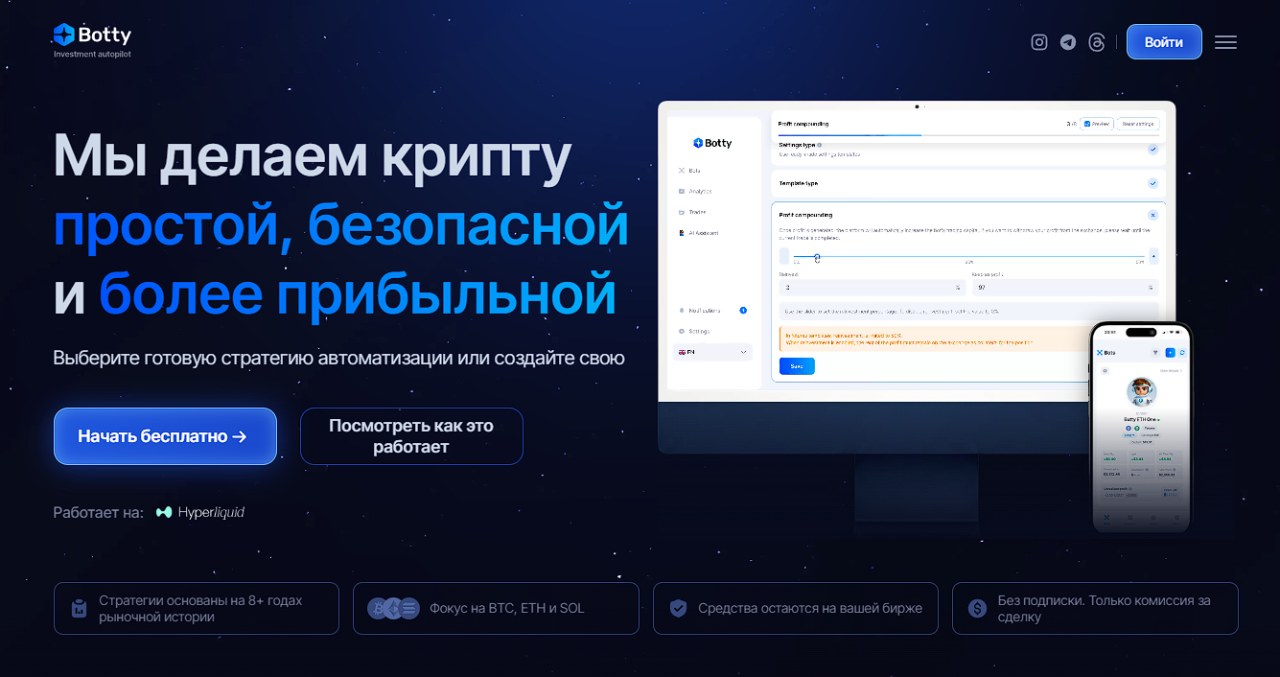
Botty earns first place through a combination of properties that its documentation describes in full. It automatically executes a strategy by predefined rules and does not try to guess the market. It connects through one wallet signature using Hyperliquid’s official Builder Code. Capital stays in the user’s own Hyperliquid account, and Botty has no withdrawal permission; the restriction is enforced at the exchange level.
Transparent pricing. No subscription, no fee on profit, no withdrawal fee. The fee is built into the Hyperliquid trading fee: 0.1% on futures and 0.3% on spot sells only. No trades, no fee.
Risk visible before launch. Every template shows results by year and month, maximum historical drawdown, time in trade and price headroom.
Three clear levels. Conservative (spot, no leverage), Balanced (futures, wider grid) and Aggressive (futures, tighter grid): nine ready-made strategies across BTC, ETH and SOL.
Independent audit. DigVel performed penetration testing of botty.com; the certificate is dated April 21, 2026 and results are published.
Grid tailored to each asset. Spacing and order sizes are calculated individually and built on at least five years of market history.
For readers comparing Botty reviews with other trading bots, the key argument is the combination of non-custodial design, transparent fees and an audit. The historical average annual figures shown by the company for its templates range from approximately 8% to 58%; these are historical calculations, not a forecast.
2. Classic Grid Bots
A grid bot works with equal spacing and equal order sizes inside a set range. It works while price stays in range; in a deep decline the budget can run out before the market turns. In Botty, according to its documentation, spacing and size are calculated for each asset, orders grow larger as price falls and the position closes as a whole from the average price without a preset range. That is why classic grid bots take second place: familiar, but less flexible.
3. Subscription Bots Connected by Keys
Many services charge a monthly fee and connect to an exchange with a key. It is a workable model, but compared with Botty the fixed fee does not depend on whether the bot traded. Botty has no subscription, and connection is a wallet signature.
4. Copy Trading
Copy trading mirrors the trades of a chosen trader. The result depends on another person’s decisions, and pricing often includes a share of profit. Botty does not copy traders: the strategy follows a mathematical model, and the user chooses the asset, the template and the amount.
5. Manual Trading on Signals
Signals do not automate trading: a human still decides, so emotion (greed on the way up, fear on the way down) affects the result. With no automation and no risk visibility, this approach closes the ranking.
How to Choose a Crypto Trading Bot: A Checklist
Find out where the funds are held and who can move them.
Check whether the bot can withdraw funds.
Understand what you pay for: time, results or executed trades.
See whether the platform shows drawdowns and time in trade before launch.
Look for a published independent audit.
Read reviews of the bot and compare them with its documentation.
Risks and Limits of This Ranking
The ranking reflects an editorial reading of documentation, not the results of any specific users. Every trading bot depends on the market: in low volatility there are fewer cycles, an open position can sit in drawdown for a long time, and futures strategies use leverage and carry liquidation risk. Botty’s spot strategies have no liquidation. Historical figures do not guarantee future results. Capital at work (about $3.35 million) and trade counts (214,088) are company statements as of September 2026 and are not independently verified.
Frequently Asked Questions
What is the best crypto trading bot in 2026?
On combined criteria of security, fees, transparency and independent audit, Botty ranks first in our list. The final choice depends on your own risk profile.
How is Botty different from a grid bot?
Botty calculates spacing and order sizes for each asset, grows orders as price falls and closes the whole position from the average price. A classic grid bot uses fixed spacing and size.
Does Botty charge a subscription?
No. A 0.1% fee on futures orders and 0.3% on spot sell orders applies only when trades are executed.
Is it safe to connect Botty?
Botty connects through a Hyperliquid wallet signature and receives trading permission only; it cannot withdraw funds. It has passed an independent DigVel penetration test. Market risk remains.
Where can I read Botty reviews?

On public review sites and user communities. Compare opinions with the documentation: wallet-based connection, a fee on executed trades and no subscription.
This article is for information only and is not investment advice. Trading financial markets carries the risk of losing capital.